
Asphalt vs. Architectural Shingles: What Bergen County Homeowners Should Choose
A clarification worth thirty seconds before we go any further, because it will save you some confusion while you are gathering quotes. “Asphalt versus architectural” is one of the most common roofing searches in New Jersey, and it compares two things that are not actually opposites.
Architectural shingles are asphalt shingles. Asphalt is the material category, and it covers more than 80 percent of American roofs according to the Asphalt Roofing Manufacturers Association. Within that category, there are three tiers, and knowing the difference will make every conversation you have with a contractor easier.
| TIER | ALSO CALLED | CONSTRUCTION |
|---|---|---|
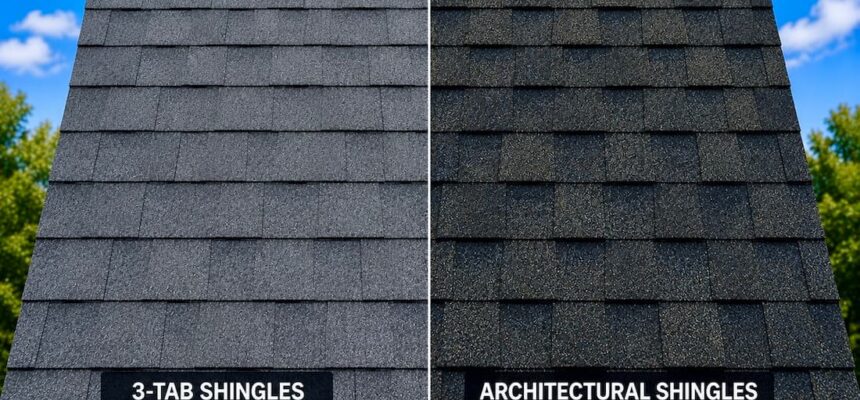
| 3-tab | Strip shingle | Single flat layer, uniform cut, visible tabs |
| Architectural | Dimensional, laminated | Two or more layers laminated together, varied cut |
| Premium / designer | Luxury | Heavier laminate, imitates slate or cedar |
So the real question most Bergen County homeowners are actually asking is 3-tab versus architectural, and secondarily, which manufacturer to choose. We answer both below, the same way we would if you were sitting across the kitchen table from us.
3-Tab vs. Architectural: The Practical Comparison
Here is how the two stack up, side by side, on the things that actually matter for a Bergen County home.
| 3-TAB | ARCHITECTURAL | |
|---|---|---|
| Installed cost (NJ) | $3.50 to $5.00 per sq ft | $4.50 to $8.00 per sq ft |
| Expected service life | 15 to 20 years | 25 to 30 years |
| Standard wind warranty | Typically 60 to 70 mph | 110 to 130 mph |
| Weight per square | Roughly 200 to 240 lb | Roughly 215 to 340 lb |
| Appearance | Flat, uniform | Dimensional shadow lines |
| Algae-resistant options | Limited | Standard on major lines |
| Fire rating | Class A | Class A |
The cost gap has closed more than most homeowners expect. On a 25-square Bergen County roof, the material difference between 3-tab and standard architectural is often only $1,500 to $2,500 on a project that is already in the $12,000 to $18,000 range. Labor, tear-off, disposal, underlayment, flashing, and ventilation are effectively identical either way, since those costs do not change based on which shingle sits on top.
The life difference, on the other hand, has not closed at all. You are buying roughly ten additional years of service for roughly 12 percent more on the total project cost. On a per-year basis, architectural is meaningfully cheaper, not more expensive, once you do the math honestly.
The wind gap is really what decides it for us. Bergen County sits in the nor’easter corridor, and a 3-tab shingle rated at 60 to 70 mph is exposed in a county where sustained gusts during a winter storm regularly exceed that number. Architectural shingles from the major manufacturers carry 130 mph warranties when installed to specification, which is not a small difference when a storm actually arrives.
Our honest position, after four decades of doing this: we specify architectural on nearly every residential reroof in Bergen County. There are two legitimate cases where we still recommend 3-tab: a detached garage or outbuilding, and a rental or flip where the owner’s holding period is genuinely short. On a home you plan to live in for any real length of time, the math simply does not favor 3-tab anymore.
GAF Timberline HDZ vs. Owens Corning TruDefinition Duration
These are the two architectural shingles we install most often, and we want to be upfront with you: both are genuinely good choices. The differences between them are real, but they are narrower than the marketing on either side would have you believe.
| GAF TIMBERLINE HDZ | OWENS CORNING DURATION | |
|---|---|---|
| Nailing technology | LayerLock with StrikeZone nailing area | SureNail woven fabric strip in the nailing zone |
| Standard wind warranty | 130 mph with specified installation | 130 mph with specified installation |
| Enhanced wind coverage | WindProven, no maximum wind speed, 15 years, requires full GAF system with 4+ qualifying accessories | Not offered as a no-cap equivalent |
| Algae warranty | StainGuard Plus, 25 years | StreakGuard, 10 years |
| Impact rating | UL 2218 Class 3 standard (Class 4 on Timberline UHDZ) | UL 2218 Class 3 standard (Class 4 on Duration STORM / FLEX) |
| Fire rating | Class A | Class A |
| Material cost per square | Roughly $95 to $130 | Roughly $95 to $120 |
| Top contractor tier | Master Elite, roughly 2 to 3% of contractors | Platinum Preferred, invitation only, roughly 1% |
| Top warranty | Golden Pledge: 50-year material, 25-year workmanship, non-prorated | Platinum Protection: lifetime material, workmanship coverage |
Where the Difference Actually Matters in Bergen County

Algae warranty goes to GAF, and this is the most consequential difference for our specific county. Bergen’s mature tree canopy means a large share of homes have shaded, slow-drying slopes where Gloeocapsa magma thrives, and the Roofing Industry Alliance for Progress has estimated that a severe algae infestation can cut shingle lifespan by up to 10 years. A 25-year algae warranty against a 10-year one is a genuine differentiator if you live in Ridgewood, Glen Rock, Tenafly, Wyckoff, or Franklin Lakes.
Wind coverage is effectively a tie for most homes, since both carry 130 mph coverage as standard. GAF’s WindProven no-cap warranty is a real advantage on exposed ridgeline properties in Mahwah, Franklin Lakes, and Upper Saddle River. Still, it requires the full GAF accessory system, not just the shingles alone. For a mid-block home in Paramus, the practical difference between the two brands here is genuinely small.
Cold-weather flexibility leans toward Owens Corning on their SBS lines. Duration FLEX and Duration STORM use polymer-modified asphalt, which stays more flexible at low temperatures and carries Class 4 impact resistance. In Bergen County’s freeze-thaw climate, that flexibility has a real argument behind it, and some insurance carriers even offer a premium credit for Class 4 rated roofs.
Color and appearance really do come down to preference rather than performance. Both Owens Corning’s TruDefinition color platform and GAF’s HDZ range offer deep shadow lines and broad palettes. Our honest advice is to walk the neighborhood and look at installed roofs in actual daylight, not to choose from a small sample board in a showroom, since colors read very differently once they are spread across an entire roof plane.
Here is the summary we give every homeowner who asks us this exact question: the installer matters more than the brand. A properly installed Duration roof will outlast a poorly installed Timberline roof, and vice versa. Choose the contractor first, and then choose between the two shingles that contractor is actually certified to install.
Wind Ratings: What 130 MPH Actually Means

Wind ratings come from ASTM D3161 and ASTM D7158 testing, conducted in a controlled chamber on properly installed, fully sealed shingles. That last part matters more than most homeowners realize, because there are three things that rating does not tell you on its own.
It assumes the specified nailing pattern was followed. A 130 mph rating typically requires six nails per shingle in high-wind applications, placed precisely in the designated nailing zone. Nails driven too high, too low, overdriven, or underdriven void the rating entirely, and honestly, this is the single most common installation defect we see in the industry.
It also assumes the sealant strip has fully activated. Shingles seal by heat, and a roof installed in December in Bergen County may not fully seal until spring arrives. That is normal, but it does mean late-season installs are more vulnerable during their first winter than they will be every winter after.
And it assumes matched components throughout. Starter strip along the eaves and rakes, and manufacturer hip and ridge cap, are usually required to keep the rated warranty intact. Cutting starter strip from leftover field shingles is a common shortcut we sometimes find on other contractors’ work, and it quietly voids coverage without anyone telling the homeowner.

Our advice is simple: ask your contractor to state the nailing pattern in the written proposal. For someone who does it correctly every time, it is a two-word answer, not a hesitation.
What Else Is in the System

The shingle itself is roughly a third of what actually keeps water out of your home. A complete roof system for a Bergen County home includes an ice barrier at the eaves and a self-adhering membrane running from the roof edge to at least 24 inches inside the exterior wall line per IRC R905.1.2; homes with deep overhangs need two full courses of it. It includes synthetic underlayment across the entire field, starter strip at both the eaves and rakes, and all new flashing, step, valley, chimney, sidewall, and kickout flashing, since reused flashing is a false economy that costs more later than it saves now.
It also includes proper ventilation, a ridge vent plus adequate soffit intake, sized to 1/150 of attic area or 1/300 where the intake-exhaust split qualifies under IRC R806.2, and hip and ridge cap matched to the shingle line. A quote that names a shingle and nothing else is not a quote for a roof system. Our roofing systems page walks through the full assembly in more detail.
When Asphalt Is Not the Right Answer

Asphalt is the right choice for the large majority of Bergen County homes, and we say that as the company that installs it most often. It is not universal, though, and we would rather tell you that upfront than sell you the wrong system for your house.
Many pre-1940 homes in Ridgewood, Glen Rock, and Tenafly were originally built with slate, and replacing slate with asphalt changes the building’s character and, on some homes, its resale positioning too. Synthetic slate holds that appearance at a much lower weight if the original material is beyond saving. Some Franklin Lakes and Saddle River homes carry cedar shake by original design or by neighborhood covenant, and that choice deserves respect, not a default swap to asphalt.
Standing seam metal roofing runs 40 to 70 years and handles snow shedding beautifully, and it is worth considering on additions, porches, and lower-slope sections even on an otherwise asphalt roof. Standing seam copper on valleys, bays, and dormer roofs is a hallmark of the higher-end homes we work on. And flat or low-slope sections, rear additions, porch roofs, and dormer tops frequently fall below the minimum slope asphalt shingles require, and need a proper membrane system instead.
Historic district review applies in several Bergen County municipalities and can restrict both material and color. Please confirm with us or with your local building department before you fall in love with a particular option.
Return on Investment

Recent editions of the Cost vs. Value Report have put asphalt shingle roof replacement recoup at roughly 57 to 68 percent, with Middle Atlantic figures sitting toward the upper part of that band. Angi’s 2026 analysis puts asphalt roof ROI at 60 to 70 percent. Those numbers are worth knowing, but they miss three things that matter just as much to a homeowner selling in this county.
A dated roof becomes a negotiating line item in any sale. Buyers, or more precisely their inspectors, price it at full replacement cost, not depreciated value, and that number comes straight off your offer. Manufacturer warranties also transfer. Both GAF Golden Pledge and Owens Corning Platinum Protection transfer once to a new owner, subject to registration deadlines, which makes a transferable warranty a documented asset at closing rather than just a nice-to-have. And insurance is increasingly roof-age sensitive. Many carriers now attach actual cash value settlement endorsements to roofs over 10 to 15 years old, which materially reduces what a storm claim actually pays out. A new roof can restore full replacement cost coverage and, with some carriers, even earn you a premium credit.
A Homeowner's Checklist Before You Choose

- Confirm you are comparing 3-tab to architectural, not asphalt to architectural; they are the same material.
- Get the wind warranty rating in writing, and ask what nailing pattern earns it.
- Weight the algae warranty heavily if any part of your roof sits under tree cover.
- Ask whether the quote includes a full roof system: ice barrier, underlayment, flashing, starter strip, and ventilation, not just shingles.
- Confirm two full courses of ice barrier if your home has deep overhangs
- Ask for a full tear-off rather than a second layer, regardless of what New Jersey code technically permits
- Check whether your municipality has historic district review before choosing material or color
- Register any transferable manufacturer warranty promptly if you plan to sell within the coverage period

Frequently Asked Questions
What is the difference between asphalt and architectural shingles?
There is no difference in material. Architectural shingles are asphalt shingles. The real comparison is between 3-tab asphalt shingles (single layer, 15 to 20 years, 60 to 70 mph wind rating) and architectural asphalt shingles (laminated multi-layer, 25 to 30 years, 110 to 130 mph).
Are architectural shingles worth the extra cost in New Jersey?
For almost every Bergen County home, yes. The cost difference on a typical project is roughly $1,500 to $2,500, and you gain about 10 years of service life plus a substantially higher wind rating in a county that is genuinely exposed to nor’easters.
Which is better, GAF or Owens Corning?
Both are excellent. GAF Timberline HDZ leads on algae coverage, 25-year StainGuard Plus versus 10-year StreakGuard, and offers the WindProven no-cap wind warranty with a full GAF system. Owens Corning’s SBS-modified Duration FLEX and STORM lines offer better cold-weather flexibility and Class 4 impact resistance. Installation quality matters more than the choice between the two.
How long do architectural shingles last in Bergen County?
Typically 25 to 30 years with correct ventilation, drainage, and ice protection. Closer to 18 to 22 years without them. We explain why Bergen County roofs age faster than most New Jersey roofs.
Do I need algae-resistant shingles?
If any slope on your home is shaded for a meaningful part of the day, yes. Algae-resistant shingles use time-release copper granules to inhibit Gloeocapsa magma. In Bergen County’s tree-lined neighborhoods, this is close to a default recommendation for us.
Can I install architectural shingles over an existing roof?
New Jersey permits up to two layers. We recommend a full tear-off regardless. Layering prevents inspection of the decking, adds weight, retains heat, shortens shingle life, and can affect warranty eligibility down the road.
What does a new roof cost in Bergen County?
Most homeowners pay $12,000 to $18,000 for architectural asphalt on a typical single-family home in 2026. Full breakdown of how much a new roof costs in Bergen County, NJ.
Talk It Through With Someone Who Installs Both
A&J Reliable has been installing asphalt, metal, slate, cedar, and copper roofs across Bergen County since 1979. We will walk your roof, look in your attic, and recommend a system for your house, not for whichever product line happens to be sitting in the truck that day.
Schedule a free roof inspection or request an estimate from our Bergen County roofing team today.




