
Why Bergen County Roofs Age Faster Than Most New Jersey Roofs
A 30-year architectural shingle does not last 30 years everywhere. That number comes from an accelerated weathering test in a laboratory, not from a roof in Wyckoff sitting under four oak trees, or a roof in Mahwah that has weathered forty winters of freeze and thaw.
We have inspected roofs across the entire tri-state area for more than four decades, and we can tell you honestly that Bergen County roofs, on the whole, reach the end of their usable life earlier than roofs in central and southern New Jersey. It is not one single cause. It is six conditions stacking on top of each other, and Bergen County happens to have an unusual concentration of all six at once. Here is what is actually happening, in roughly the order of how much impact each one has.
1. The Housing Stock Is Old, and Old Roofs Sit on Old Assemblies

Let’s start with the least glamorous factor, because it quietly explains more than anything else on this list. According to American Community Survey data published by the New Jersey Department of Health, 74.6 percent of Bergen County’s 368,535 residential housing units were built before 1980. Statewide, that figure is 63.6 percent. Nationally, it is 50.5 percent. Only Union, Passaic, and Essex counties come close within New Jersey. Bergen County’s median construction year sits around 1960, and roughly 30 percent of homes here went up before 1950.
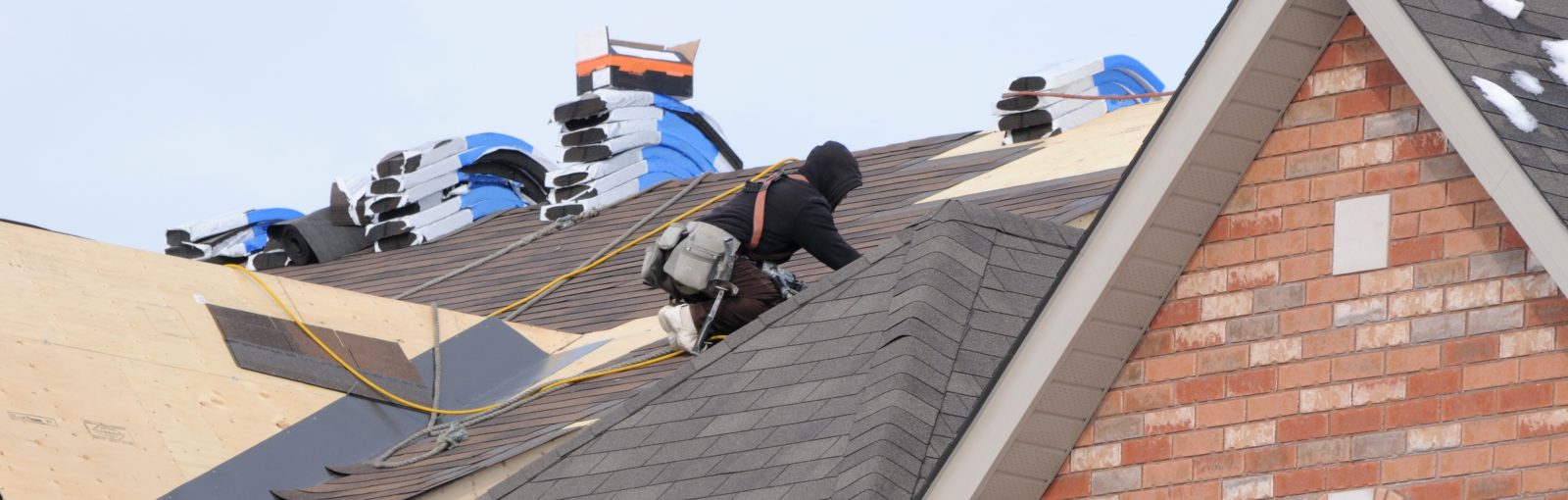
Age matters for reasons that have nothing to do with the shingles sitting on top. Pre-war homes were sheathed in 1x plank decking with gaps between the boards, not the plywood or OSB sheets used today, which gives fasteners less holding power and gives ice barrier membrane an imperfect surface to bond to. Attics insulated during the 1970s and 1980s were frequently filled without addressing air sealing or preserving soffit intake, so blown-in insulation packed into the eave quietly chokes off the ventilation the roof depends on. New Jersey permits two layers of roofing, and plenty of Bergen County homes have carried two at some point, which runs hotter and hides deck damage underneath it. And older homes simply accumulate more penetrations over the decades: masonry chimneys, added bath fans, retrofitted kitchen exhaust, satellite mounts, dormers added during a 1990s expansion. Every penetration is a flashing detail, and flashing details are where roofs actually leak.
None of this shows up on a shingle warranty card. All of it shortens real-world roof life, and it is the first thing we look for when we walk a Bergen County attic.
2. Can I See Your Certificate of Insurance, Sent Directly From Your Agent?

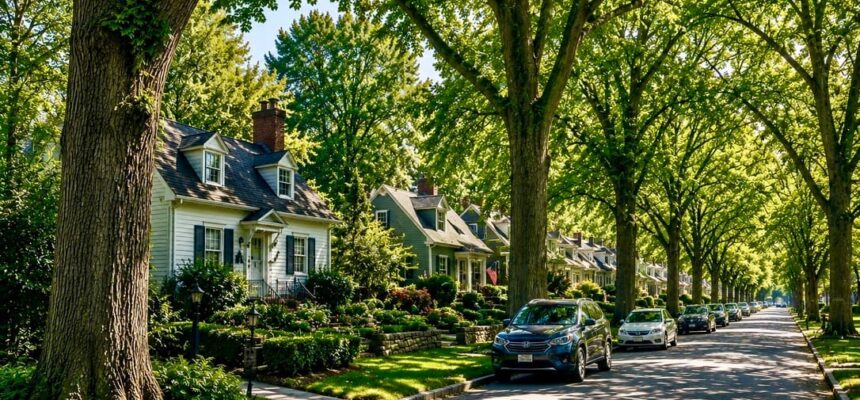
Ridgewood, Glen Rock, Tenafly, Wyckoff, Franklin Lakes, and Ho-Ho-Kus are defined in part by mature street trees and wooded lots, and honestly, that canopy is one of the things that makes this county such a beautiful place to live. New Jersey’s urban tree cover has been estimated at roughly 48 percent, with about 179 million trees on urban and community land statewide, according to research cited by the NJDEP. Bergen County’s established residential neighborhoods sit well within that pattern.
Trees affect a roof in four separate ways, and we see all four every week. Shade keeps slopes wet, since a north-facing slope under canopy can stay damp for hours after an exposed slope nearby has already dried. That persistent moisture sets the stage for algae and moss to colonize. The dark streaking you see on shaded slopes is Gloeocapsa magma, a blue-green alga that feeds on the limestone filler in asphalt shingles. It is mostly cosmetic early on, but moss is a different story entirely. Moss holds water directly against the shingle mat, lifts the tab edges as it grows underneath, and accelerates granule loss. The Roofing Industry Alliance for Progress has estimated that a severe algae infestation can cut shingle lifespan by up to 10 years.
Trees also load the drainage system. Leaves, needles, and seed pods clog gutters and valleys, and a blocked valley backs water sideways under the shingle course while a blocked gutter backs water up under the first course at the eave and feeds ice dams come winter. This is exactly why we consider gutter cleaning to be roof maintenance rather than landscaping, and why gutter guards pay for themselves faster in heavily wooded towns. Overhanging limbs also abrade and impact the roof, scouring granules on windy days and occasionally coming down entirely during a nor’easter.
What slows it down: trim branches back from the roof plane, keep gutters clear twice a year, and treat algae with a low-pressure roof washing rather than a pressure washer, since pressure washing strips granules and voids most manufacturer warranties. On replacement, specify a shingle with a long algae warranty. GAF Timberline HDZ carries 25-year StainGuard Plus coverage, while Owens Corning Duration carries 10-year StreakGuard. In a shaded Bergen County backyard, that difference is genuinely meaningful over the life of the roof.
3. Freeze-Thaw Cycling
Bergen County straddles two climate situations, which is part of why generic New Jersey roofing advice fits it so poorly. The county’s northwestern corner, Mahwah, Oakland, Franklin Lakes, Ramsey, and Wyckoff, sits in or against New Jersey’s Northern climate zone, which the Office of the New Jersey State Climatologist at Rutgers describes as averaging 40 to 50 inches of snow annually with 163 freeze-free days in the northern highlands, leaving roughly 200 days a year when a freeze is possible. The eastern edge along the Hudson, Fort Lee, Edgewater, Cliffside Park, is moderated by the river and runs measurably warmer.

The damage mechanism is not the cold itself. It is the cycling. Water enters a hairline crack in a shingle, at a nail head, or in chimney mortar. It freezes, expands roughly nine percent, and widens the gap. It thaws, penetrates a little further, and repeats. Northern New Jersey’s winters are almost perfectly suited to this because they hover around the freezing point instead of staying reliably well below it. Asphalt shingles also lose flexibility in the cold, so a shingle that would simply flex under a wind gust in October cracks instead in February. That is one real argument for polymer-modified SBS shingles in the county’s colder towns. Annual precipitation in north-central New Jersey runs 43 to 51 inches, near the top of the statewide range, so there is never a shortage of water available to drive the cycle.
4. Ice Dams

Ice dams are the most expensive winter roof problem we see in Bergen County, and honestly, the most misdiagnosed. Here is the sequence: snow accumulates on the roof. Heat escaping from the living space through the ceiling warms the underside of the deck and melts the snow directly above it. That meltwater runs down the slope to the overhang, which stays unheated because there is no conditioned space beneath it, and refreezes there. The refrozen ridge slowly grows into a dam, water pools behind it, and because shingles are designed to shed water flowing downhill rather than sitting still against them, it works its way under the courses and into the roof assembly.
The damage shows up as ceiling stains along exterior walls, peeling paint at the top of interior walls, wet insulation, gutters pulled clean off the fascia, and in the worst cases, mold inside the wall cavity. Two code provisions address this directly, and both are frequently under-delivered by contractors in a hurry. Under IRC R905.1.2, a self-adhering polymer-modified bitumen ice barrier membrane must run from the lowest edge of every roof surface to a point not less than 24 inches inside the exterior wall line. On Bergen County homes with deep overhangs, a single 36-inch course simply does not reach that line, and two courses are required. It is one of the easiest items for a low bidder to shortchange, because nobody sees it after the first day. Under IRC R806.2, net free ventilating area must equal 1/150 of the vented attic space, reducible to 1/300 when at least half the ventilation sits in the upper portion of the roof with the balance at the soffits.

The underlying cause is rarely the roof covering itself. It is heat loss and unbalanced ventilation, and a roof that drops ice dams every winter has an air sealing and insulation problem that a new layer of shingles will not fix on its own. If a dam has already formed, roof snow removal before the next storm cycle is far cheaper than repairing what the dam does once it sets in.
5. Wind
Bergen County sits squarely in the nor’easter corridor. These storms arrive from late fall through early spring, hold sustained winds for many hours rather than minutes, and drive rain horizontally, which happens to be the direction shingles are least able to resist. Nationally, wind and hail account for roughly 42 percent of all homeowners insurance losses, with an average claim severity near $13,511, according to Insurance Information Institute data from 2018 through 2022. Roofs and windows are consistently the most exposed components on any home.
Wind damage on an aging roof tends to be progressive rather than dramatic. A shingle loses its seal in one storm and becomes a lever. The next storm lifts it further and breaks the seal on the shingle above it. Three seasons later, a slope has a bare patch that looks like it failed overnight, but it did not. Exposure also varies quite a bit within the county. Homes on ridgelines in Mahwah, Franklin Lakes, and Upper Saddle River, and homes with unobstructed western approaches, take considerably more wind load than a house sitting mid-block in Bergenfield.
What slows it down: architectural shingles rather than 3-tab. Both GAF Timberline HDZ and Owens Corning Duration carry 130 mph wind warranties when installed to specification with the manufacturer’s matching starter strip and ridge cap. GAF’s WindProven limited warranty carries no maximum wind speed at all for 15 years, but only when the roof is installed as a complete GAF system with at least four qualifying accessories. In our experience, installation quality determines real-world wind performance far more than brand selection alone ever does.
6. Ventilation and Humidity: The Quiet One

If you fix only one thing on this entire list, fix this one. An under-ventilated attic damages a roof from below, invisibly, all year round. In summer, trapped heat drives attic temperatures far above the outside air, and that heat accelerates asphalt oxidation and the loss of the volatile oils that keep shingles flexible. A shingle cooking at 150 degrees for months at a time simply does not reach its rated service life, no matter what the warranty card says.
In winter, warm moist air from the living space migrates up into the attic, condenses on the cold underside of the deck, and produces frost. When that frost thaws, it wets the sheathing, and repeated across many winters, that process delaminates plywood and rots plank decking. Homeowners usually find it during a tear-off, and it is always more expensive than anyone expected. Bergen County makes this worse in three specific ways. The housing stock is old enough that most attics were insulated as retrofits, and retrofit insulation routinely blocks soffit intake without anyone realizing it. Bath and kitchen exhaust fans in older homes were often terminated straight into the attic rather than through the roof, which is both a code violation and a direct moisture source. And the county’s summer humidity, moderated by its proximity to the Hudson, gives condensation plenty of material to work with.
The most common defect we find is insufficient intake, not insufficient exhaust. A ridge vent without matching soffit intake cannot move air properly, and in some configurations it actually pulls conditioned air out of the house instead, which raises heating costs and adds moisture to the attic at the same time. Ask your contractor how they will handle both intake and exhaust, and whether they actually looked in your attic before answering. If ventilation is not a line item on the proposal, it was not part of the plan.
What This Means for Roof Life in Bergen County
Manufacturer literature and generic guides put architectural asphalt at 25 to 30 years, and that number is genuinely achievable here in Bergen County. It just requires a few things to be done right, and we put together a simple chart showing what actually moves the needle.
| FACTOR | EFFECT ON SERVICE LIFE |
|---|---|
| Correct attic ventilation, intake and exhaust balanced |
Largest single positive factor |
| Ice barrier installed to 24 inches inside the wall line |
Prevents the most expensive winter failure |
| Gutters kept clear, branches trimmed back | Removes moisture and debris load |
| Algae and moss treated by soft wash, not pressure wash |
Preserves granules; up to 10 years of shingle life |
| Architectural shingle with a full accessory system |
Wind performance and warranty eligibility |
| Full tear-off rather than a second layer | Allows deck inspection; avoids heat retention |
Without those factors in place, the same roof in the same town typically runs closer to 18 to 22 years, and it is entirely normal for us to inspect a 30-year roof at year 19 and find that it is already finished.
A Homeowner's Checklist: What to Ask About and Watch For

- Ask whether your attic has both intake and exhaust ventilation, not just a ridge vent.
- Confirm ice barrier coverage reaches at least 24 inches inside the exterior wall line, two courses if your overhangs are deep.
- Clean gutters and trim overhanging branches at least twice a year, and consider gutter guards if tree cover makes it a constant chore.
- Treat algae and moss with a low-pressure soft wash, never a pressure washer.
- Choose an architectural shingle with a full accessory system if you are replacing your roof, not just the shingles alone.
- Insist on a full tear-off rather than a second layer whenever your roof is replaced.
- Ask your contractor to inspect the attic before quoting the job, not after signing the contract.

Frequently Asked Questions
How long does a roof last in Bergen County, NJ?
Architectural asphalt shingles typically deliver 25 to 30 years here when ventilation, drainage, and ice protection are correct, and 18 to 22 years when they are not. Three-tab shingles run 15 to 20 years. Metal, slate, and copper run considerably longer.
Why is my roof failing before the warranty period ends?
Manufacturer warranties cover defects in the shingle itself, which are genuinely rare. They do not cover premature aging caused by inadequate ventilation, poor drainage, or moss. Nearly every early failure we inspect traces back to installation quality or attic conditions rather than to the shingle itself.
Does tree cover really shorten roof life?
Yes, through moisture retention, algae and moss growth, debris in the drainage system, and abrasion. It is a real trade-off for a beautiful, shaded property. The answer is management, trimming, gutter maintenance, and periodic soft washing, not removing the trees.
Are ice dams a roof problem or an insulation problem?
Almost always insulation and air sealing. The roof assembly can mitigate the damage through proper ice barrier coverage, and good ventilation helps keep the deck cold, but the heat driving the melt is coming from inside the house.
Do I need better attic ventilation?
Signs include frost or dark staining on the underside of the roof deck in winter, an attic that is uncomfortably hot in summer, ice dams, and a mildew smell. Blocked soffit vents are the most common cause and are easy to check yourself from inside the attic at the eaves.
Which shingle is best for Bergen County?
An architectural asphalt shingle from a major manufacturer, installed as a complete system with a matched starter strip, ridge cap, ice barrier, and a proper ventilation plan. In heavily shaded neighborhoods, we weigh the algae warranty heavily when making a recommendation.
We Have Been Watching This Happen Since 1979
A&J Reliable has roofed Bergen County homes for more than four decades from our office in Nanuet. We inspect the attic before we ever quote a roof, because on most of these houses, the attic is where the real answer lives, not the shingles themselves. We would rather take the extra twenty minutes and get the recommendation right than sell you a roof that looks fine today and disappoints you in year nineteen.
Schedule a free roof inspection or request an estimate from our Bergen County roofing team today.




